
Overview
assemblykor provides seven built-in datasets from the
Korean National Assembly for teaching quantitative methods in political
science:
-
legislators: 963 MP records (20th-22nd assemblies) -
bills: 64,900 legislative bills -
wealth: 3,215 legislator-year asset declarations -
seminars: 5,962 legislator-year seminar activity records -
speeches: 15,795 committee speech records (22nd, Science & ICT) -
votes: 8,611 plenary vote tallies (20th-22nd) -
roll_calls: 549,513 member-level roll call votes (22nd)
library(assemblykor)
#>
#>   ┌───────────────────────────────────────────────────────────────┐
#>   │ assemblykor 0.1.4                                             │
#>   │ Korean National Assembly Data for Political Science Education │
#>   └───────────────────────────────────────────────────────────────┘
#>
#>   7 built-in datasets:
#>     legislators    963 recs   MPs (20-22nd)
#>     bills       64,900 recs   Bills proposed
#>     wealth       3,215 recs   Asset declarations
#>     seminars     5,962 recs   Policy seminars
#>     speeches    15,795 recs   Committee speeches (22nd, Sci & ICT)
#>     votes        8,611 recs   Plenary vote tallies
#>     roll_calls 549,513 recs   Member-level votes (22nd)
#>
#>   Downloadable:
#>     get_bill_texts()           Bill propose-reason texts
#>     get_proposers()            Co-sponsorship records
#>     get_speech_tokens()        Morpheme tokens for speeches (Kiwi)
#>
#>   Tutorials:
#>     list_tutorials()           See all 9 tutorials
#>     run_tutorial(1)            Launch in browser (interactive)
#>     open_tutorial(1)           Copy Rmd to working directory
#>
#>   Korean font for ggplot2:     set_ko_font()
#>
#>   CRAN releases may lag behind. For the latest data and fixes:
#>     remotes::install_github("kyusik-yang/assemblykor")
#>     https://github.com/kyusik-yang/assemblykor
1. Exploring legislator data
data(legislators)
str(legislators)
#> 'data.frame':    963 obs. of  15 variables:
#>  $ member_id    : chr  "XQ98168F" "60490713" "IH436704" "8I61593E" ...
#>  $ assembly     : int  20 20 20 20 20 20 20 20 20 20 ...
#>  $ name         : chr  "강길부" "강병원" "강석진" "강석호" ...
#>  $ name_hanja   : chr  "姜吉夫" "姜炳遠" "姜錫振" "姜碩鎬" ...
#>  $ name_eng     : chr  "KANG GHILBOO" "KANG BYUNGWON" "KANG SEOGJIN" "KANG SEOKHO" ...
#>  $ party        : chr  "무소속" "더불어민주당" "자유한국당" "자유한국당" ...
#>  $ party_elected: chr  "무소속" "더불어민주당" "새누리당" "새누리당" ...
#>  $ district     : chr  "울산 울주군" "서울 은평구을" "경남 산청군함양군거창군합천군" "경북 영양군영덕군봉화군울진군" ...
#>  $ district_type: chr  "constituency" "constituency" "constituency" "constituency" ...
#>  $ committees   : chr  "교육문화체육관광위원회, 예산결산특별위원회, 4차 산업혁명 특별위원회, 산업통상자원중소벤처기업위원회" "국회운영위원회, 환경노동위원회, 정치발전 특별위원회, 예산결산특별위원회, 헌법재판소장(이진성) 임명동의에 관한 "| __truncated__ "국회운영위원회, 보건복지위원회, 예산결산특별위원회, 농림축산식품해양수산위원회" "안전행정위원회, 행정안전위원회, 정치개혁 특별위원회, 정보위원회, 외교통일위원회, 농림축산식품해양수산위원회" ...
#>  $ gender       : chr  "M" "M" "M" "M" ...
#>  $ birth_date   : Date, format: "1942-06-05" "1971-07-09" ...
#>  $ seniority    : int  4 1 1 3 4 1 1 2 1 1 ...
#>  $ n_bills      : int  314 1078 694 585 1131 393 1478 934 1284 1056 ...
#>  $ n_bills_lead : int  21 94 53 43 89 74 75 55 78 64 ...
Gender composition by assembly
gender_tab <- table(legislators$assembly, legislators$gender)
gender_tab
#>
#>        F   M
#>   20  53 267
#>   21  64 258
#>   22  66 255
prop.table(gender_tab, margin = 1)
#>
#>              F         M
#>   20 0.1656250 0.8343750
#>   21 0.1987578 0.8012422
#>   22 0.2056075 0.7943925
Legislative productivity by seniority
boxplot(n_bills_lead ~ seniority, data = legislators,
        xlab = "Terms served", ylab = "Bills proposed (as lead)",
        main = "Seniority and Legislative Productivity",
        col = "lightblue")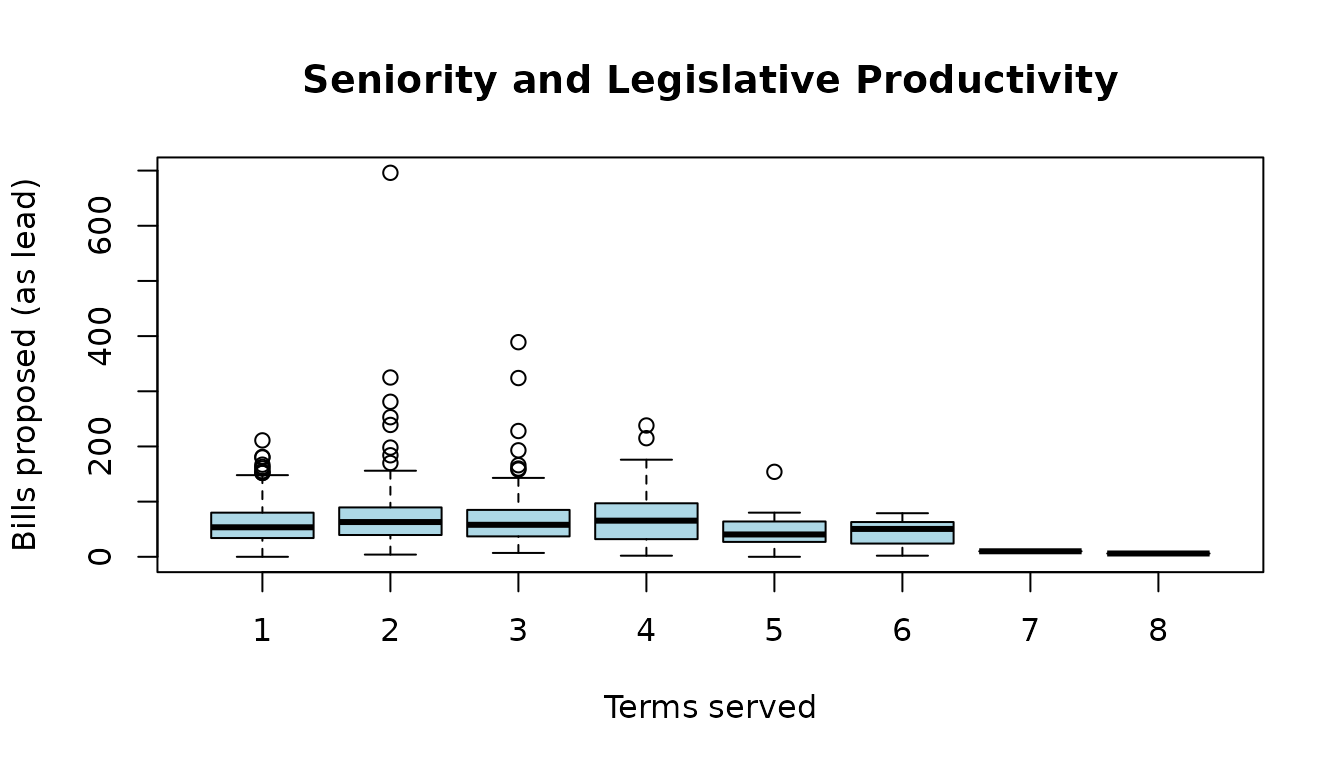
Bill counts vary widely at every level of seniority. The median is highest among members in their first or second term.
2. Bill outcomes
data(bills)

# Top 5 outcomes
outcome_counts <- sort(table(bills$result), decreasing = TRUE)
barplot(outcome_counts[1:5], las = 2, col = "steelblue",
        main = "Most Common Bill Outcomes")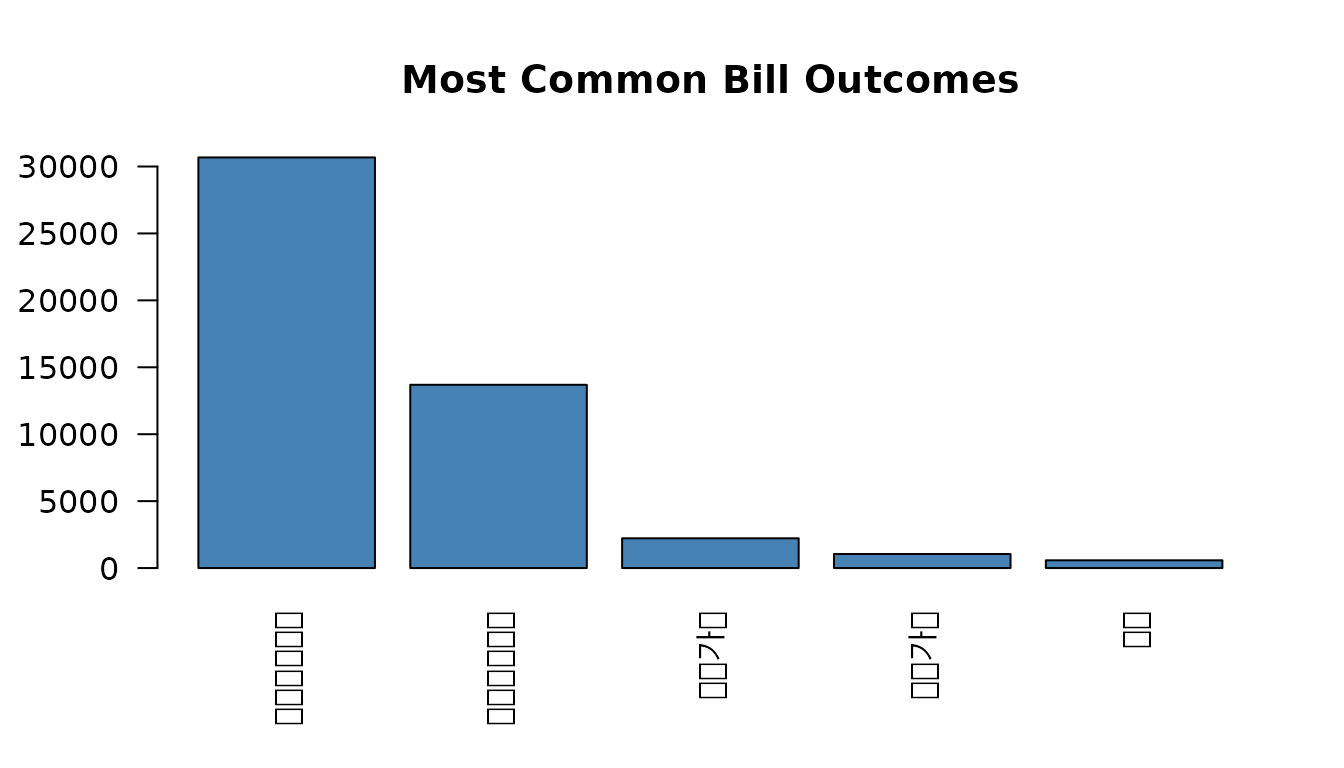
Most bills expire at the end of the assembly term (임기만료폐기). Only a small fraction pass in their original form (원안가결).
Bills per month
bills$month <- format(bills$propose_date, "%Y-%m")
monthly <- aggregate(bill_id ~ month, data = bills, FUN = length)
names(monthly) <- c("month", "count")
monthly <- monthly[order(monthly$month), ]

plot(seq_len(nrow(monthly)), monthly$count, type = "l",
     xlab = "Month (index)", ylab = "Bills proposed",
     main = "Monthly Bill Proposals (20th-22nd Assembly)")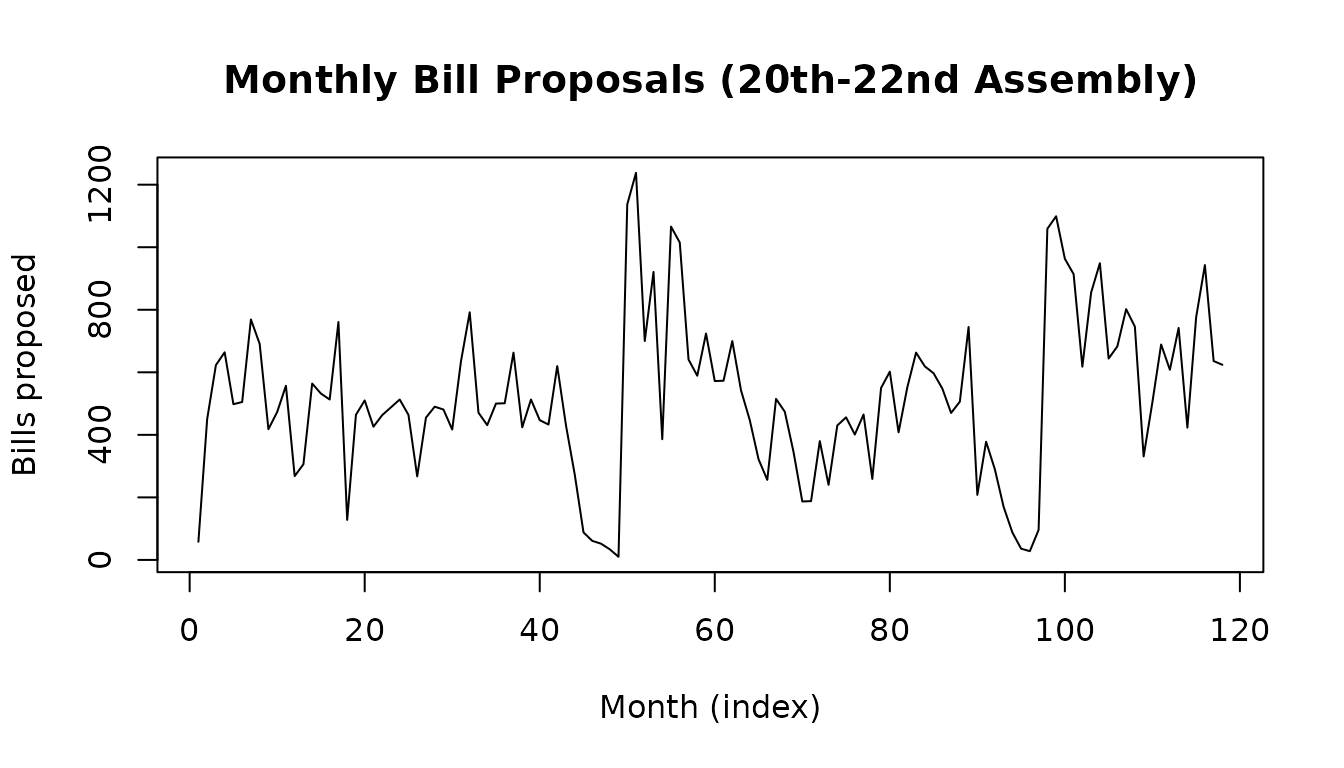
3. Wealth panel
The wealth dataset is a legislator-year panel ideal for
practicing fixed-effects regression.
data(wealth)

# Distribution of net worth
hist(wealth$net_worth / 1e6, breaks = 50, col = "coral",
     main = "Legislator Net Worth Distribution",
     xlab = "Net Worth (billion KRW)")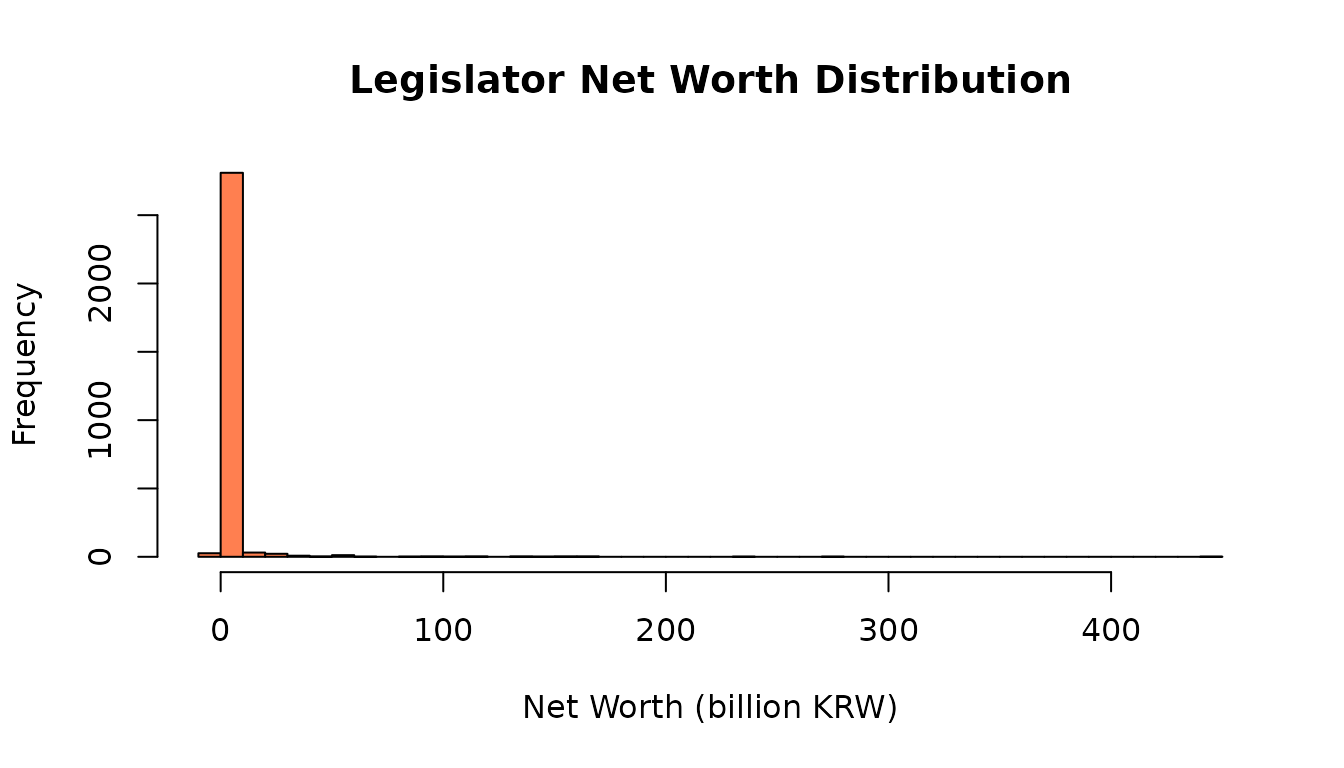
Real estate concentration
wealth$re_share <- ifelse(wealth$total_assets > 0,
                          wealth$real_estate / wealth$total_assets, NA)

boxplot(re_share ~ year, data = wealth,
        xlab = "Year", ylab = "Real estate / total assets",
        main = "Real Estate as Share of Legislator Wealth",
        col = "lightyellow")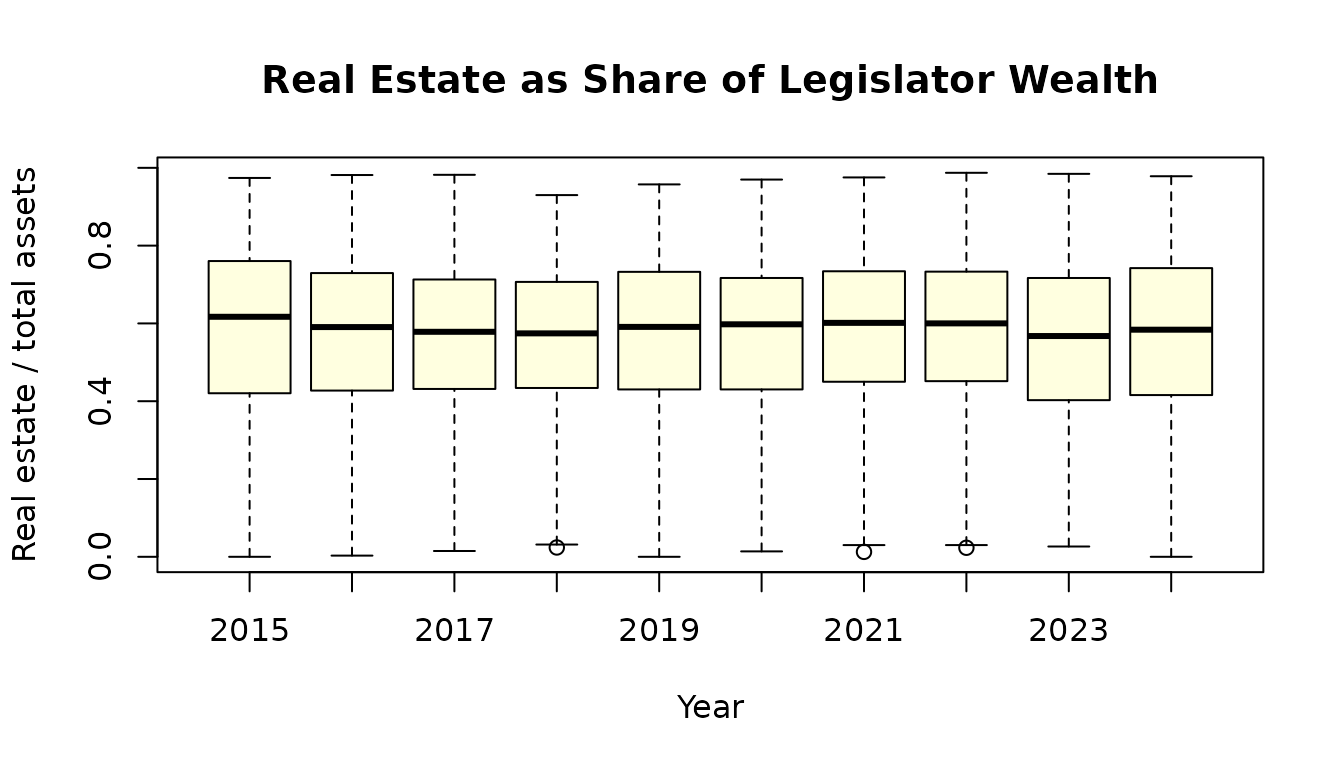
Korean legislators hold a large share of their wealth in real estate, reflecting broader patterns in Korean household wealth.
4. Policy seminars and cross-party cooperation
data(seminars)

# Governing vs opposition party
gov_means <- tapply(seminars$cross_party_ratio,
                    seminars$is_governing, mean, na.rm = TRUE)
barplot(gov_means, names.arg = c("Opposition", "Governing"),
        ylab = "Cross-party ratio", col = c("dodgerblue", "tomato"),
        main = "Cross-Party Seminar Collaboration")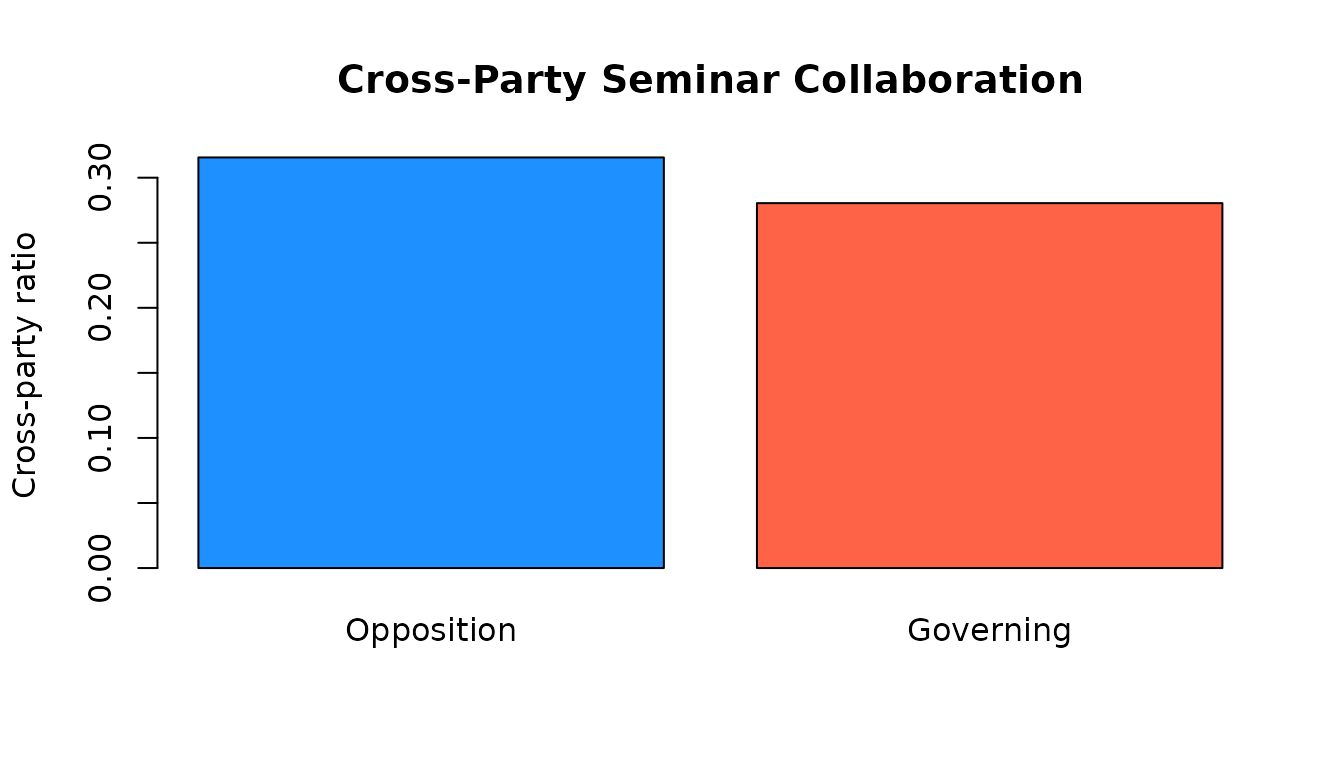
Governing-party legislators tend to have lower cross-party collaboration in policy seminars, a pattern consistent with the “closing ranks” hypothesis.
5. Joining datasets
All datasets share the member_id and/or
assembly columns:
library(dplyr)

# Merge legislators with wealth
leg_wealth <- legislators %>%
  inner_join(wealth, by = "member_id", relationship = "many-to-many")

# Productivity vs wealth
leg_wealth %>%
  group_by(district_type) %>%
  summarise(
    n = n(),
    median_net_worth = median(net_worth / 1e6, na.rm = TRUE),
    median_bills = median(n_bills_lead, na.rm = TRUE)
  )
#> # A tibble: 2 × 4
#>   district_type     n median_net_worth median_bills
#>   <chr>         <int>            <dbl>        <dbl>
#> 1 constituency   4950             1.50           64
#> 2 proportional    528             1.25           68
6. Plenary votes
data(votes)

# Yes-vote share distribution
votes$yes_rate <- votes$yes / votes$voted
hist(votes$yes_rate, breaks = 40, col = "lightgreen",
     main = "Distribution of Yes-Vote Share",
     xlab = "Proportion yes")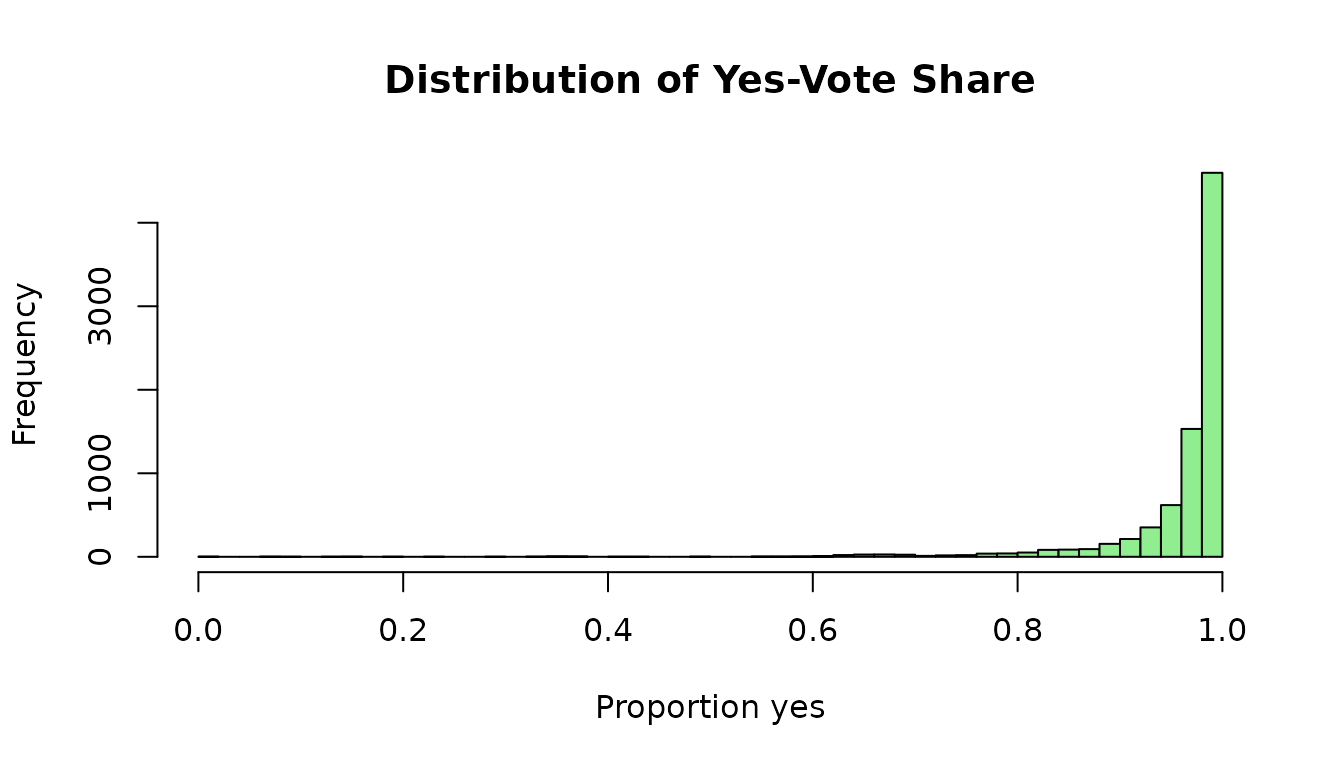
Most bills pass with near-unanimous support. The left tail reveals contested legislation where party discipline breaks down.
7. Roll call analysis
data(roll_calls)
library(dplyr)

# Party discipline: how often do members vote with their party majority?
party_votes <- roll_calls %>%
  group_by(bill_id, party) %>%
  mutate(party_majority = names(which.max(table(vote)))) %>%
  ungroup() %>%
  mutate(with_party = vote == party_majority)

party_votes %>%
  group_by(party) %>%
  summarise(
    n_members = n_distinct(member_id),
    discipline = mean(with_party, na.rm = TRUE)
  ) %>%
  filter(n_members >= 5) %>%
  arrange(desc(discipline))
#> # A tibble: 4 × 3
#>   party        n_members discipline
#>   <chr>            <int>      <dbl>
#> 1 조국혁신당          14      0.880
#> 2 더불어민주당       178      0.832
#> 3 국민의힘           112      0.715
#> 4 무소속               8      0.710
8. Speech patterns
data(speeches)

# Who speaks most in committee?
leg_speeches <- speeches[speeches$role == "legislator", ]
speaker_counts <- sort(table(leg_speeches$speaker_name), decreasing = TRUE)
barplot(speaker_counts[1:10], las = 2, col = "plum",
        main = "Top 10 Most Active Speakers (Sci & ICT Committee)")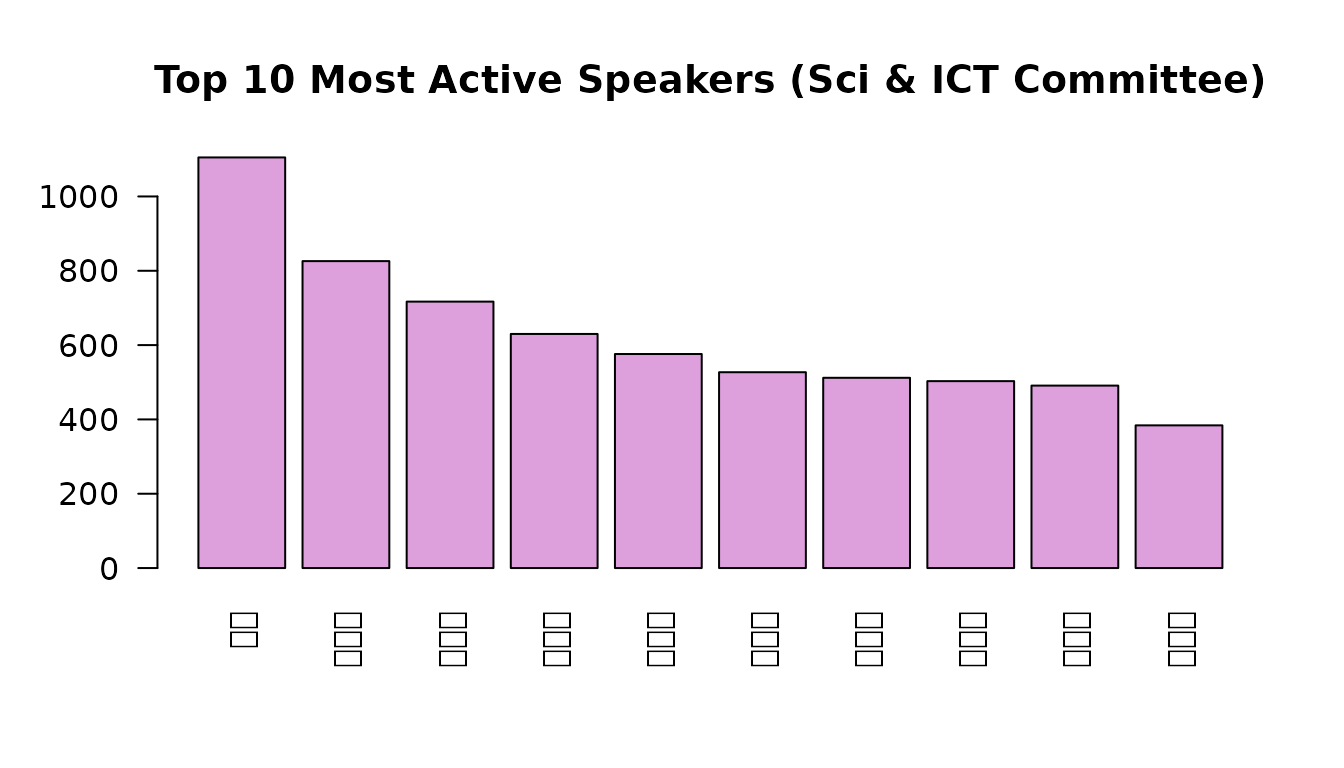
Next steps
For text analysis, download the bill propose-reason texts:
texts <- get_bill_texts()For network analysis, download the full co-sponsorship records:
proposers <- get_proposers()See vignette("codebook") for the full data dictionary,
or ?get_bill_texts and ?get_proposers for
download function details.