Annual panel of policy seminar hosting activity for legislators in the 17th through 22nd Korean National Assembly. Policy seminars (jeongchaek semina) are informal legislative events where MPs invite experts, stakeholders, and colleagues from other parties to discuss policy issues.
Format
A data frame with 5,962 rows and 18 variables:
- name
Legislator name in Korean
- member_id
Legislator identifier (MONA_CD, links to
legislators$member_id). Available for 5,696 rows (95.5\ andNAfor unmatched or ambiguous (homonym) cases.- year
Calendar year
- assembly
Assembly number (17-22), assigned from the calendar year (2004-2007 to the 17th, 2008-2011 to the 18th, and so on)
- party
Party affiliation
- camp
Political camp: "liberal", "conservative", "progressive", "centrist", or "other" (values are in Korean)
- seniority
Seniority at that assembly, that is, the number of terms served up to and including this one, counting terms before the 17th (1 = first-term)
- n_seminars
Number of policy seminars hosted that year
- n_cross_party
Number of seminars co-hosted with other-party legislators
- cross_party_ratio
Share of seminars that were cross-party (0-1)
- avg_coalition_size
Average number of co-hosts per seminar
- is_governing
Logical: belongs to the governing (presidential) party
- is_female
Logical: female legislator
- is_proportional
Logical: holds a proportional-representation seat in that assembly
- is_seoul
Logical: represents a Seoul district in that assembly
- province
Province or metropolitan city of the electoral district in that assembly, in Korean short form (e.g., Seoul, Gyeonggi).
NAfor proportional-representation members.- total_terms
Total assembly terms served across the career, as of September 2026
- n_bills_led
Number of bills the legislator proposed as lead proposer in that assembly term (the same value in every year of the term)
Source
National Assembly Seminar Database, collected via API. Member attributes from kna 0.7.0 (https://github.com/kyusik-yang/kna).
Details
Policy seminars are a distinctive feature of the Korean National Assembly.
Unlike floor speeches or committee hearings, seminars are voluntary and
allow legislators to signal policy expertise and build cross-party ties.
The cross_party_ratio variable captures how often a legislator
cooperates across party lines in this informal arena.
The is_governing variable enables difference-in-differences designs:
when a party transitions from opposition to governing (or vice versa),
does its members' cross-party collaboration change?
The member attributes seniority, total_terms,
is_female, is_proportional, is_seoul and
province come from the member records of release 0.7.0 of the
kna project, matched on member_id and assembly. Up to
version 0.1.3 they were matched on the name alone and counted only the
terms from the 17th assembly on. They are NA when a row has no
member_id, and all but total_terms and is_female
are NA when the legislator did not serve in that assembly.
The panel counts seminars by name and year. Because a new assembly
begins on May 30 of an election year, the rows of an election year
also hold the activity of members of the outgoing assembly, under the
new assembly number. Legislators who share a name with another member
of the same assembly have one row per year for both of them, with
member_id NA.
Examples
data(seminars)
# Cross-party collaboration by governing status
tapply(seminars$cross_party_ratio, seminars$is_governing, mean, na.rm = TRUE)
#> FALSE TRUE
#> 0.3155702 0.2804488
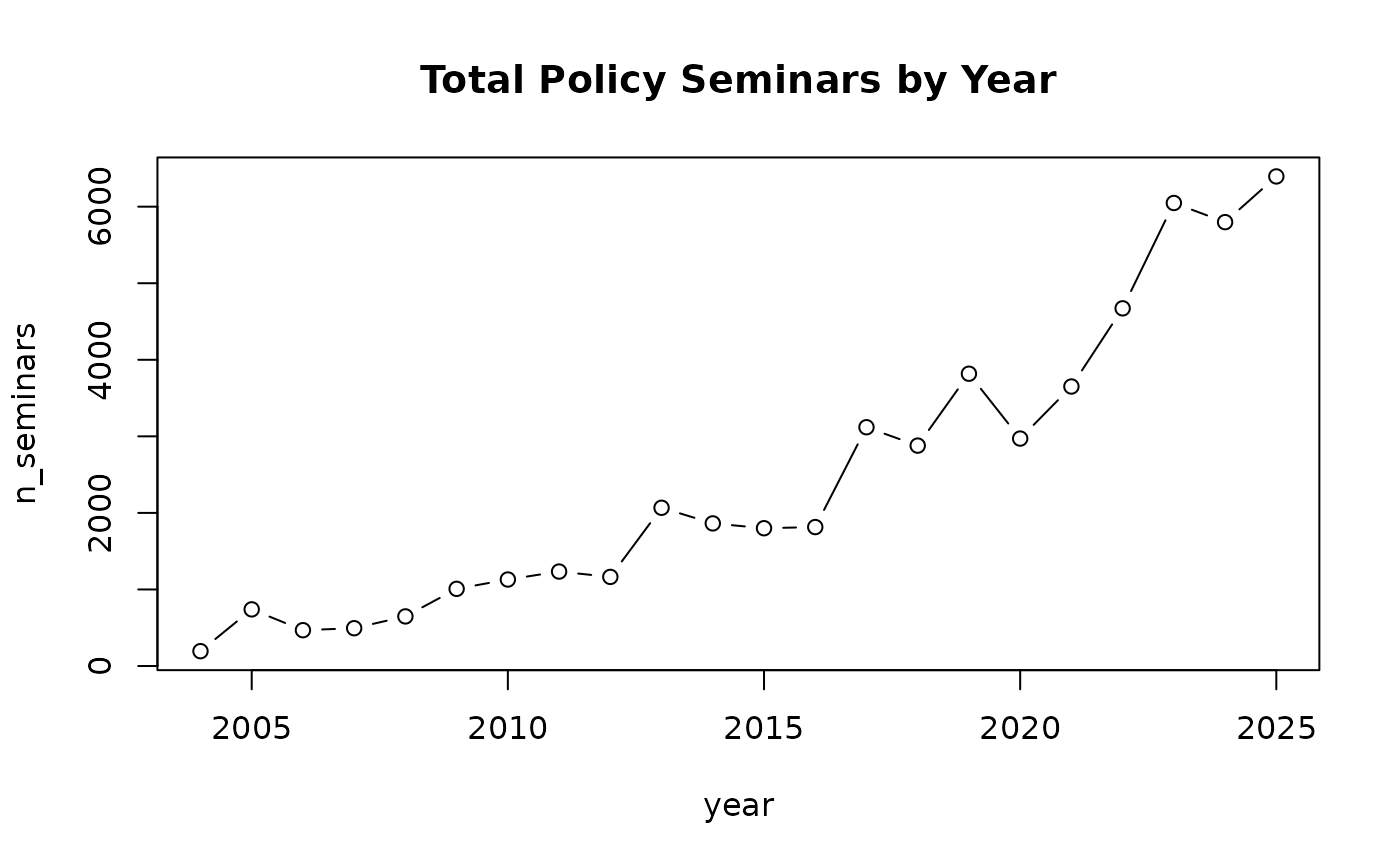
# Seminar activity over time
agg <- aggregate(n_seminars ~ year, data = seminars, FUN = sum)
plot(agg, type = "b", main = "Total Policy Seminars by Year")
 # Gender gap in seminar hosting
tapply(seminars$n_seminars, seminars$is_female, median, na.rm = TRUE)
#> FALSE TRUE
#> 5 9
# Gender gap in seminar hosting
tapply(seminars$n_seminars, seminars$is_female, median, na.rm = TRUE)
#> FALSE TRUE
#> 5 9